
Logistics Functions
The KOKUBU Group’s logistics network
The KOKUBU Group connects Japan through 328 logistics centers nationwide, from Hokkaido in the north to Okinawa in the south.
locations in Japan
328 locations
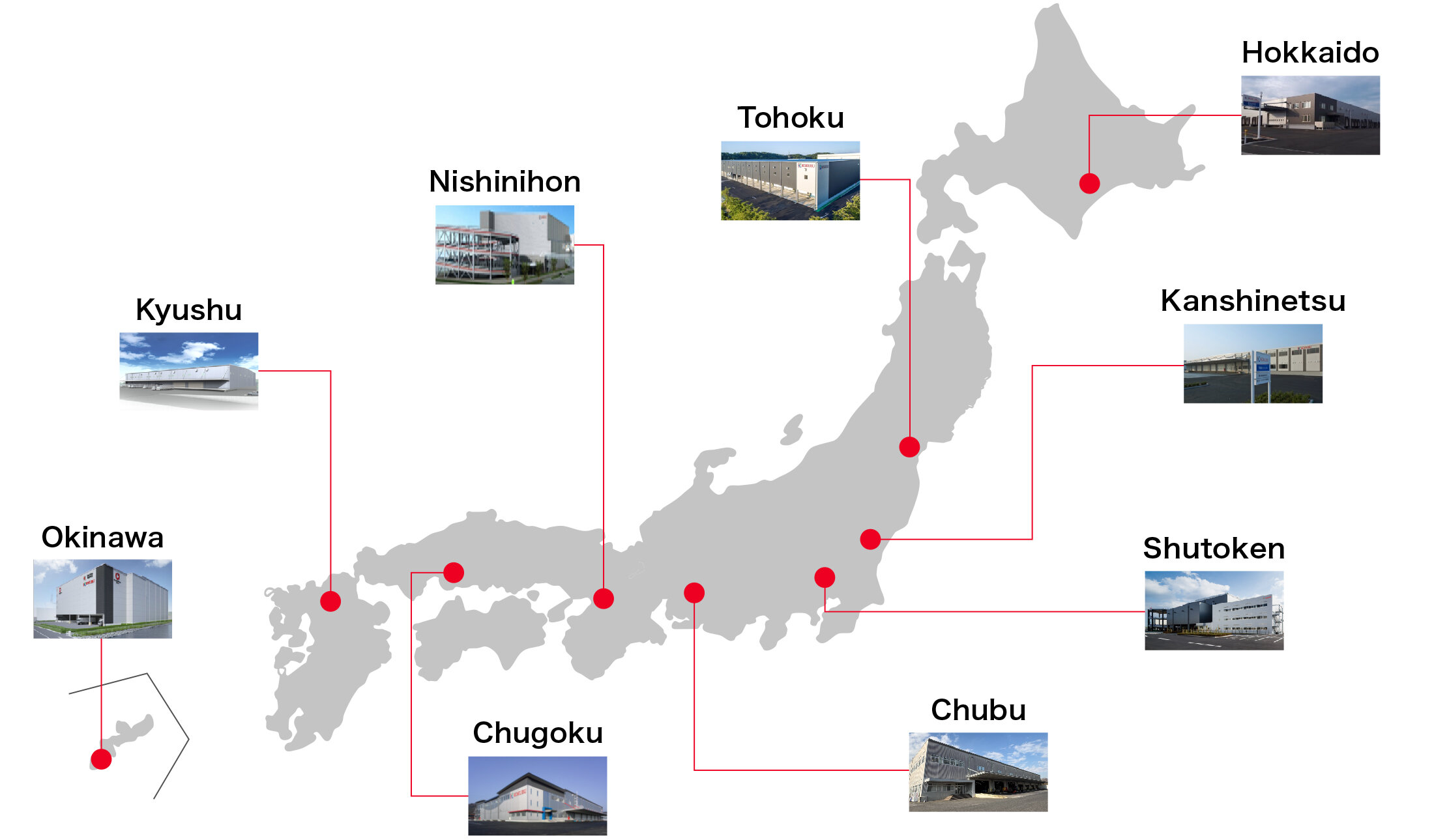
Logistics infrastructure supporting nationwide wholesaling closely tied with local communities
The KOKUBU Group’s general-purpose logistics centers are the foundation supporting food in Japan.
We integrate management of tens of thousands of items in three temperature zones—ambient, refrigerated, and frozen—between manufacturers and clients. We predict future labor shortages and environmental changes, handle staff reduction and labor saving with logistics DX, and use the latest technology to appropriately maintain product quality and realize economical operations. This allows us to respond promptly to customers’ diverse needs and proactively expand our logistics business with a sustainable distribution foundation that continues to support food infrastructure.
Number of centers
| Area | Ambient temperature | Cold chain | Total |
| Hokkaido | 18 | 12 | 30 |
| Tohoku | 15 | 13 | 28 |
| Kanshin etsu |
26 | 11 | 37 |
| Shutoken | 46 | 32 | 78 |
| Chubu | 28 | 23 | 51 |
| Nishinihon | 39 | 25 | 64 |
| Kyushu | 32 | 8 | 40 |
| Total | 204 | 124 | 328 |
(As of the end of May 2025)
By general-purpose and exclusive centers
| Number of ambient-temperature locations | Number of cold chain locations | Total | |
| General-purpose centers | 131 | 87 | 218 |
| Company-exclusive centers | 73 | 37 | 110 |
| Total | 204 | 124 | 328 |
(As of the end of May 2025)
Staff-reducing and labor-saving functions at the KOKUBU Group
The KOKUBU Group aims to increase business efficiency and reduce burden at field sites by promoting staff reduction and labor saving at logistics locations and accelerating the introduction of logistics DX.
Truck arrival reception and reservation system
We are working to reduce driver waiting and stopping time in food distribution.
- Industry-standard system
- Minimizing the need for individual handling and separate operations at each site, and having a system that anyone can use without hesitation, effectively promotes staff reduction and labor saving. Receiving and verification work that previously required human labor has also been automated, leading to improved work efficiency.
- Information gathering
- It is also possible to ascertain waiting and unloading time for each delivery vehicle, as well as times of truck congestion at logistics centers, and more. This leads to planning for new initiative policies through analysis and study based on accurate figures, including for facility entries, unloading, and facility exits, which were previously difficult to obtain due to paper-based operations.
- Reduction of time for truck waiting, loading and unloading work, etc.
- Advance reservation of expected receiving times substantially reduces waiting time after arrival at logistics centers.
Productivity management system (PMS)
Control of labor time and management of actual versus forecast results improve work efficiency.
- Productivity visualization
- Managing the start of work shifts, the start and end of work and breaks, and leaving work as data allows for confirming how far work has progressed for each labor process. It is also possible to ascertain daily results and working hours by individual and process based on the recorded time information.
- Also effective for shift scheduling
- Applying past data to accurately collected work progress and labor time allows for optimal staff deployment and shift creation, and effective staff reduction can be anticipated.
Automatic guided vehicles (AGVs)
Picking robot-hand system (PRS)
Autonomous mobile robots (AMRs)
The introduction of advanced machines for materials handling achieves substantial improvements in staff reduction, labor saving, and work efficiency at logistics sites.
- Improving the labor shortage
- Allocating transportation and picking work that previously relied on human labor to robots makes it possible to minimize the staff needed for those tasks.
- Workload reduction
- Heavy objects and large quantities of packages can be transported without relying on human labor, which substantially reduces the physical burden on workers and is effective for labor saving.
- Work status and data accumulation
- The promotion of logistics DX allows for the linking of robots with systems and visualization of onsite work status and data in real time. Analysis of this data maximizes work efficiency.
Transportation management system (TMS)
Our operational management system completely manages transportation and delivery to products’ destinations after they are shipped from a logistics center.
- Ascertaining actual operations
- We promote digitization of delivery information to respond to challenges in the logistics industry such as the driver shortage and optimization of working hours. Ascertaining actual operations is essential for planning and implementing optimization including improving loading efficiency, shortening truck waiting time, and shortening time for loading and unloading work. Drivers can break away from conventional analog records and operations dependent on experience, realizing more accurate and efficient delivery management and data accumulation.
- Reducing the number of delivery vehicles, operation time, etc.
- Analysis based on data accumulated via the TMS makes it possible to optimize driving routes and improve loading efficiency. As a result, we will be able to reduce staff and save labor, such as through reduced working hours for drivers and integration of delivery routes, achieving countermeasures to the driver shortage as well as the implementation of safe, stable delivery work.